
Views: 0 Author: Site Editor Publish Time: 2026-10-27 Origin: Site
Did you know a single component failure beneath your deck can completely ruin high-value heavy cargo? Stability is never just a luxury when transporting oversized or highly sensitive equipment. It is an absolute engineering necessity. Moving massive machinery puts relentless, immense stress on standard transport frames. You need a reliable, precisely engineered system to prevent catastrophic accidents and protect your capital investment.
The secret to handling massive weight capacities while maintaining a smooth ride lies entirely in the undercarriage design. This comprehensive guide breaks down exactly how heavy-duty suspension systems operate under extreme stress. We will explore the specific mechanics behind different configurations and provide a clear framework to help you select the perfect setup for your fleet's operational demands.
The Critical Lifeline: The undercarriage acts as the primary bridge between the rigid chassis and the road surface. It distributes extreme weight evenly across all axles, preventing localized structural stress and sudden tire blowouts.
Engineered Variety: There is no universal solution for heavy hauling. Mechanical, pneumatic, hydraulic, and single-point setups each serve highly specific load requirements, terrain profiles, and budget constraints.
Axle Synergy: High-capacity hauling demands perfect harmony between the structural framework and multi-axle configurations. Simply adding axles only increases your legal payload if the mechanical system can effectively share that load.
Investment Protection: Selecting the correct architecture based on objective payload data minimizes long-term maintenance costs. It directly maximizes the structural lifespan of your transport equipment.
Frequently referred to in the logistics industry as a lowboy, a low bed semi trailer is a highly specialized heavy-haul transport vehicle. Its defining structural feature is a unique drop-deck design. Unlike standard flatbeds, the deck drops down immediately after the gooseneck. It remains incredibly close to the ground before rising again over the rear wheels. This specialized geometry serves a vital purpose. It significantly lowers the center of gravity for the cargo, allowing operators to safely transport excessively tall machinery without violating highway bridge clearance regulations.
However, the physical demands placed on these vehicles are extreme. Picture an operator loading a massive 80-ton excavator or a heavy-duty industrial transformer onto the deck. The immediate, concentrated load is immense. This is precisely where the undercarriage becomes the most critical component of the entire vehicle.
Without a robust connection between the rigid steel chassis and the wheel axles, the trailer frame would absorb all the kinetic energy generated by road imperfections. The sheer force of hitting a pothole at 50 mph would lead to rapid metal fatigue, cracked welds, and eventual catastrophic failure. The undercarriage performs three indispensable jobs. It absorbs violent road shocks, maintains consistent tire contact with the ground for critical braking traction, and distributes concentrated weight evenly across the entire bed.
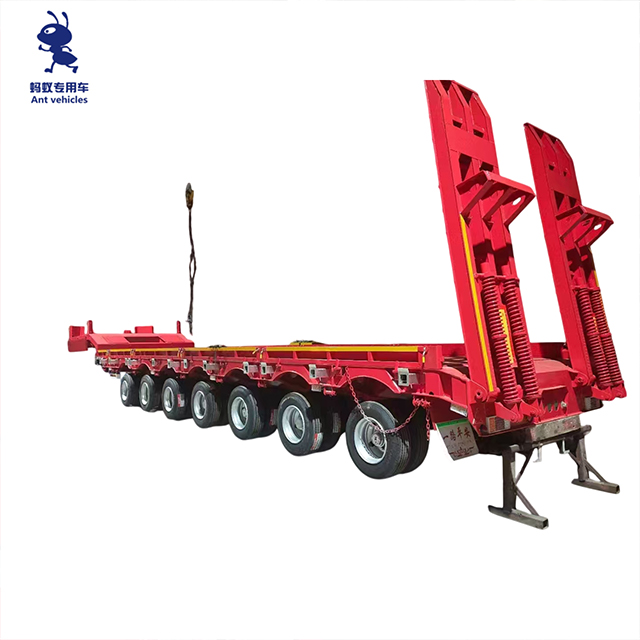
To truly understand how these systems survive under such stress, we must look at the mechanical physics of weight distribution, shock absorption, and stability control.
When you haul 80 tons of machinery, that weight cannot rest solely on one or two tires. If a single axle bears the full brunt of a deep rut, the axle will snap, or the tires will instantly blow out. Modern systems utilize advanced load-sharing mechanisms. Engineers use equalizing beams in mechanical setups or interconnected air valves in pneumatic configurations. When one wheel hits a bump and is forced upward, the mechanical force or air pressure is instantly transferred to the adjacent axles. This dynamic equalization ensures the weight remains evenly distributed, keeping the per-axle load within safe, legal operational limits.
Kinetic energy is generated constantly as a vehicle moves over uneven surfaces. The goal is to absorb and dissipate this energy before it reaches the fragile cargo or the rigid frame. Depending on the engineering design, this is achieved through the violent compression and rebound of heavy-duty steel leaf springs, the cushioning of reinforced rubber airbags, or the displacement of fluid inside high-pressure hydraulic cylinders. Slowing down the transfer of kinetic force prevents the cargo from bouncing, shifting, or snapping its securement chains.
Ground clearance is minimal due to the drop-deck design. A failing system could easily cause the belly of the trailer to scrape the asphalt when crossing steep railway tracks. Modern configurations dynamically maintain the ride height. Keeping the ultra-low deck perfectly level eliminates lateral swaying. This is absolutely crucial for preventing roll-overs when transporting top-heavy cargo like wind turbine components through tight, winding routes.
Choosing the right architecture requires an objective understanding of how different mechanical systems operate under real-world stress. Below is a detailed breakdown of the four primary architectures utilized in the heavy hauling industry.
The mechanical leaf spring setup is the traditional, battle-tested standard. It works through a series of semi-elliptical steel plates stacked on top of one another and clamped tightly together. These spring packs are mounted to the axles and connected to the frame via hangers and equalizing beams. When a bump is encountered, the steel leaves flex and rub against each other. This intense internal friction absorbs the shock.
Its primary advantage is rugged durability and cost-effectiveness. It contains no electronic sensors, delicate air lines, or fluids that can leak. This makes it exceptionally reliable for off-road construction sites and remote mining operations. Maintenance is straightforward, usually requiring only visual inspections and routine greasing. While it does not offer the smoothest ride, its sheer structural resilience makes it a staple for rugged environments.
Pneumatic systems replace traditional heavy steel springs with reinforced rubber airbags. This setup relies on an engine-driven air compressor, storage tanks, and precision leveling valves. As the load increases or decreases, the leveling valves automatically detect changes in the ride height. They pump compressed air into or release it from the airbags to maintain a perfectly level deck.
The most significant benefit here is superior shock absorption. It provides an exceptionally smooth ride. This is mandatory when transporting sensitive, fragile, or highly calibrated cargo like aerospace components. Furthermore, drivers can manually adjust the deck height, lowering it to pass under low bridges or raising it to clear steep obstacles.
Representing the absolute pinnacle of heavy-haul engineering, this system utilizes high-pressure fluid cylinders connected to a centralized accumulation system. When a wheel encounters an obstacle, the cylinder compresses. This forces fluid through valves into accumulators that absorb the shock using pressurized nitrogen gas.
This is strictly essential for moving ultra-heavy, oversized industrial modules weighing 100 tons or more. Hydraulic setups offer independent axle lifting and unparalleled deck leveling capabilities on severely sloped ground. The fluid pressure ensures every single tire maintains exact, equal contact with the road, preventing the structural twisting of the chassis under extreme payloads.
Commonly known as a bogie setup, this is a specialized mechanical configuration designed primarily for extreme off-road conditions. Rather than having independent leaf springs for each axle, it features a single, heavy-duty central pivot point connecting two axles on each side in a seesaw configuration.
When the front tire goes over a large rock, it pivots upward on the central trunnion. This forcefully pushes the rear tire down to maintain constant ground contact. While heavier and less suited for high-speed highway travel, it provides incredible axle articulation for deep mud, uneven quarries, and unpaved forestry terrains.
The heavy transportation industry is currently undergoing a significant technological shift. Market analysis reveals a strong transition toward predictive maintenance and intelligent load management. Fleet managers are moving away from traditional reactive repairs. Instead, modern suspension setups increasingly integrate Internet of Things sensors directly into pneumatic and hydraulic circuits. These smart sensors deliver real-time telemetry on payload weight distribution, individual tire pressure, and component fatigue. This precise data allows engineers to replace parts right before they fail, drastically reducing highway breakdowns.
In addition to digitization, regulatory pressures regarding road damage are pushing manufacturers to adopt advanced lightweight alloys. Reducing the tare weight of suspension components without sacrificing yield strength is a major focus. Lighter undercarriages mean transport companies can legally increase payload capacities, thereby maximizing the profitability of every single trip. We are also seeing a rise in electronic braking integration and self-steering axle technologies working in tandem with the suspension. This synergy significantly reduces tire scrub on tight corners and improves overall operational safety.
A suspension system does not operate in a vacuum. Its performance is entirely dependent on the axle configuration it supports. The relationship between these two elements dictates both the maximum legal payload and how effectively the vehicle navigates the road.
When payloads exceed standard limits, simply reinforcing the steel chassis is never enough. The immense weight must be spread over a larger surface area to prevent damaging highway infrastructure. Consequently, multi-axle configurations become mandatory. For instance, operating a four axle low bed semi trailer requires a highly specialized load-sharing suspension. This ensures that an 80 to 100-ton load is distributed so perfectly that no single axle exceeds local legal weight limits.
Specifically, modern air and hydraulic systems allow for the integration of lift axles. A lift axle can be pneumatically raised off the pavement when the trailer is empty. This synergy drastically reduces toll costs, improves fuel efficiency by minimizing rolling resistance, and saves thousands of dollars in wear and tear on expensive heavy-duty tires.
Selecting the optimal setup is a critical engineering decision that directly impacts safety and operational profitability. Fleet managers must carefully evaluate their primary cargo types and typical operating environments before making a purchasing decision.
Feature | Mechanical Leaf Spring | Air Suspension | Hydraulic Suspension |
|---|---|---|---|
Primary Mechanism | Steel spring packs & equalizers | Rubber airbags & leveling valves | Fluid cylinders & accumulators |
Shock Absorption | Moderate (Stiff ride) | Excellent (Smooth ride) | Superior (Dynamic leveling) |
Maintenance Cost | Low (Basic tools needed) | Medium (Valves, lines) | High (Pumps, fluid, seals) |
Best Terrain | Rough, off-road, rugged sites | Paved highways, smooth roads | Sloped, highly uneven terrain |
Objective Recommendations based on load profile:
Choose Mechanical if: You operate in severe off-road conditions and prioritize budget and maintenance simplicity. It is ideal for hauling standard heavy machinery like excavators or bulldozers that can withstand significant vibration.
Choose Air if: You transport highly sensitive, high-value equipment that requires a vibration-free ride. It is also necessary if your routes require frequent deck height adjustments to clear bridges and load safely.
Choose Hydraulic if: Your operations involve moving ultra-heavy, oversized cargo exceeding 100 tons. This setup is mandatory for precise load equalization and independent steering capabilities to navigate complex routes.
Regardless of the technology you select, the extreme weights carried by heavy haulers subject the undercarriage to immense mechanical stress. Implementing a rigorous, preventative maintenance schedule is the only proven method to mitigate the risk of catastrophic failure at highway speeds.
Technicians must conduct a thorough visual audit before any major haul. For mechanical setups, inspect the steel leaves for hairline fractures near the center bolt. For air systems, listen carefully for the distinct hiss of a pneumatic leak and check the rubber bags for dry rot. Hydraulic systems require close inspection of cylinder seals. Even a minor fluid weep indicates a failing seal that could lead to a sudden loss of pressure.
Metal-on-metal friction is the primary enemy of structural longevity. Equalizers, pivot points, and torque arm bushings must be greased at strict intervals. Utilizing a high-quality, extreme-pressure lithium-complex grease ensures the lubricant remains intact under the immense shearing forces generated by heavy payloads. Lack of lubrication leads to seized equalizers. This forces the axles to absorb shocks rigidly until the frame eventually cracks.
U-bolts secure the system to the axles. Under the extreme stress of heavy loads, these bolts will naturally stretch as they settle. It is a critical industry standard to check and re-torque U-bolts to factory specifications after the first 1,000 miles of operation on a new trailer. Loose U-bolts allow the axle to shift out of alignment, causing severe tire degradation.
The delivery network is just as important as the shocks themselves. Air lines must be regularly purged of moisture. Water trapped in pneumatic lines can freeze during winter operations, destroying height control valves. Similarly, hydraulic fluid must be sampled and replaced according to schedule to prevent microscopic metal shavings from degrading internal cylinder walls.
The final step in optimizing your logistics is matching your average payload data with the correct trailer combination. Over-engineering your purchase leads to unnecessary capital expenditure. Under-engineering leads to dangerous equipment failure.
Start by assessing your maximum routine payload. If your daily operations involve moving massive 80 to 100-ton loads, standard setups are simply insufficient. For these applications, deploying a high capacity low bed trailer equipped with advanced load-sharing mechanics is highly recommended. The integration of additional axles ensures that massive weight is distributed evenly, preventing individual axle overloading and protecting the chassis from twisting.
Conversely, if your fleet operations are focused heavily on rugged construction sites, durability is paramount. For moving heavy trenchers across unpaved, unpredictable terrain, an 80-ton low bed truck trailer equipped with a reinforced mechanical leaf spring suspension offers exceptional reliability. It requires less specialized maintenance in remote areas while providing the rigid strength necessary to survive constant off-road impacts.
By carefully matching the technology and axle count to your specific operational demands, you protect your capital investment, ensure regulatory compliance, and guarantee the safe delivery of high-value freight.
Understanding the intricate mechanics beneath your trailer is critical for successful heavy hauling. The right setup ensures safety, efficiency, and legal compliance on the road. It actively protects your valuable cargo from kinetic damage during transit, while proper, proactive maintenance extends the life of your entire fleet. Choose your configuration wisely to reduce costly downtime. To explore engineered solutions tailored to your exact payload profile, review the robust configurations available at Ant Vehicles and protect your next heavy haul.
The primary difference lies in the engineering geometry and the resulting center of gravity. Flatbed suspensions are mounted directly beneath a straight chassis, resulting in a higher deck height designed for standard freight. Low bed suspensions are engineered with a specialized drop-deck design, allowing the components to sit significantly lower to the ground. This ultra-low profile accommodates exceptionally tall cargo without violating bridge clearance regulations and lowers the center of gravity to prevent rollovers.
While theoretically possible from an engineering standpoint, upgrading from a mechanical to an air or hydraulic system is highly complex and generally cost-prohibitive. The chassis is specifically reinforced at the factory to accommodate the stress points of its original setup. Retrofitting requires extensive cutting, welding, and structural re-engineering. It is almost always more reliable and cost-effective to purchase a trailer with the correct, factory-installed high-capacity system.
The lifespan is heavily dependent on the operating environment and the strictness of the maintenance schedule. Under normal highway conditions with proper, routine lubrication and regular U-bolt torque checks, a mechanical leaf spring setup can reliably last between 5 to 10 years. However, in highly corrosive environments or extreme off-road mining applications, metal fatigue accelerates, and components may require replacement every 2 to 3 years to maintain safety.
Lifting axles, typically operated via an integrated pneumatic system, offer significant economic advantages when the trailer is running empty. By lifting one or two axles off the pavement, the operator immediately eliminates the rolling resistance of those tires. This results in measurable fuel savings, drastically extends tire lifespan, and can significantly reduce operational toll costs in jurisdictions where fees are calculated by the number of axles in contact with the road.
Proper alignment is maintained by regularly inspecting and adjusting the torque arms connected to the axles. Misalignment usually manifests as uneven, rapid tire wear or the trailer dog-tracking behind the truck. Technicians use laser alignment tools to measure the axle position relative to the kingpin. Adjusting the threaded ends of the torque arms allows engineers to bring the axles back into perfect parallel alignment, ensuring smooth towing and extending tire life.
Yes, absolutely. The undercarriage is designed to absorb and dissipate kinetic energy. If a component like an equalizer seizes due to lack of lubrication, or an airbag blows out, that kinetic energy bypasses the dampening system. The force of hitting bumps is transferred rigidly and directly into the steel chassis. Over time, this intense, repetitive stress causes metal fatigue, leading to cracked welds and eventual structural failure of the main frame beams.


