
Views: 0 Author: Site Editor Publish Time: 2026-08-09 Origin: Site
Loading heavy machinery presents the highest-risk phase of any transport operation. A single miscalculation can trigger catastrophic accidents, equipment damage, or severe operator injury. This operational hazard is directly influenced by the physical geometry of your trailer. You must carefully manage core variables like deck height, ramp length, and the resulting approach angle to ensure safe loading. Incorrect angles lead to equipment bottoming out, sudden traction loss, and accelerated ramp fatigue. Conversely, suboptimal deck heights heavily restrict routing options due to strict bridge clearance limits. Selecting a Low Bed Semi Trailer requires aligning your specific fleet dimensions with the correct loading geometry. Doing so helps you effectively balance site safety, operational efficiency, and load compliance. In this guide, you will learn the physics behind approach angles, how different heavy equipment interacts with ramps, and which trailer designs best mitigate implementation risks.
The ideal low bed trailer ramp angle depends entirely on the breakover angle and ground clearance of the specific heavy equipment being loaded.
Lower deck heights allow for steeper ramps without bottoming out, but trade off with trailer ground clearance and suspension travel.
Mathematically, doubling the ramp length halves the loading angle, but significantly increases trailer weight and aerodynamic drag.
Evaluating a Heavy Equipment Trailer requires calculating the specific load-over height alongside the standard operating terrain to ensure safe compliance and loading capability.
Deck height and ramp length mathematically dictate your loading slope. The formula relies on simple rise over run. You take the vertical deck height and divide it by the horizontal ramp length. Commercial operations typically target angles between 10° and 15°. Any angle steeper than 15° exponentially increases risk. Equipment tires lose grip on steep slopes. Machine engines struggle against gravity. You need an optimal incline to maintain smooth forward momentum. Managing this geometry prevents dangerous stalls during the loading sequence.
The breakover point sits exactly where the ramp meets the trailer deck. This intersection acts as a critical constraint. Long-wheelbase equipment gets high-centered easily at this spot. Low-clearance machines scrape their undercarriages. If the transition angle feels too acute, you risk catastrophic damage. Operators often ignore this hidden geometry. They focus solely on the initial approach angle from the ground. You must evaluate the entire travel path over the hinge. A smooth transition prevents the machine from resting on its chassis.
You must map out your geometry before attempting to load. Using a formulaic approach removes dangerous guesswork. Rise over run calculations yield your exact slope. Follow these steps to calculate your ideal setup:
Measure your deck height from the ground to the flat trailer bed.
Identify the lowest ground clearance point on your machinery.
Determine the required horizontal ramp length using a geometric slope calculator.
Verify the breakover angle allows the machine's wheelbase to cross safely.
Below is a baseline evaluation matrix for standard configurations:
Deck Height (inches) | Ramp Length (feet) | Approximate Loading Angle (degrees) |
|---|---|---|
36 | 12 | 14.0° |
36 | 16 | 10.6° |
24 | 10 | 11.3° |
24 | 12 | 9.5° |
Minimizing deck height improves your loading angle. However, this creates a strict operational trade-off. A lower deck directly compromises the trailer's ground clearance. You will struggle to navigate uneven job sites. Deep mud becomes entirely impassable. Railroad crossings pose severe high-centering risks for the trailer itself. You must balance safe loading with transit viability. Selecting the right setup requires analyzing your typical delivery environments. Extreme low-profile setups belong on paved highways, not remote dirt sites.
Tracked machines boast incredible traction. However, they remain highly vulnerable during steep inclines. Operators face severe tipping hazards. A steep ramp pushes the machine's center of gravity backward. As the tracks cross the apex, the weight suddenly shifts forward. This abrupt transition can slam the equipment onto the deck. You must ensure the slope stays gentle. Gentle slopes prevent violent rocking motions. To protect tracked machinery during loading, operators should:
Ensure tracks are completely clear of heavy mud before climbing.
Maintain a slow, continuous forward speed.
Avoid steering adjustments while positioned on the incline.
These machines lack meaningful ground clearance. They require the lowest possible low bed trailer ramp angle, often well under 10°. A steep incline causes their undercarriages to scrape immediately. You must utilize extended ramps or specialized bi-fold designs. Sometimes, operators deploy custom low-profile trailers entirely. These solutions prevent devastating frame damage during the loading phase. Common Mistake: Attempting to load a scissor lift onto a standard step-deck usually destroys the machine's battery box at the breakover point.
Long-wheelbase loaders present unique spatial challenges. We must focus heavily on the breakover point vulnerability. The distance between the front and rear axles spans several feet. As the front wheels level out on the deck, the rear wheels remain far down the incline. Suspension compression during loading alters the effective clearance angle further. Heavy machines compress their tires and shocks. This dynamic settling reduces your calculated clearance. Operators must account for this compression to avoid high-centering heavy loaders.
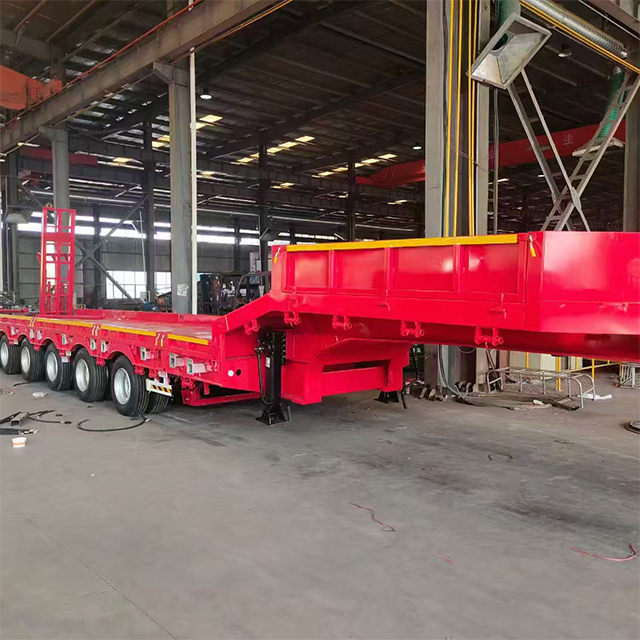
Fixed rear ramps offer distinct mechanical simplicity. Operators deploy them quickly using basic springs. They remain highly popular for general freight. However, they carry strict physical limitations.
Pros: They are highly cost-effective to manufacture. You face zero hydraulic points of failure. Fast manual deployment saves time for lighter machinery.
Cons: You are strictly limited by maximum viable length. Excessive length adds massive tare weight. Long ramps also create terrible aerodynamic drag during highway transit. You hit a physical wall where longer ramps become prohibitive.
Bi-fold designs effectively solve the length problem. They fold in half for vertical storage. Operators love the hydraulic deployment ease. Push-button operation reduces physical strain on drivers.
Pros: This design achieves a significantly lower approach angle. It avoids excessive vertical storage height during transport.
Cons: You face increased maintenance overhead for hydraulic pumps. Hoses leak and hinges wear out over time. They require substantially higher initial capital expenditure. Furthermore, the added tare weight directly reduces your legally allowable payload capacity.
Extreme heavy equipment demands different solutions. Removable Gooseneck trailers detach from the truck cab entirely. You drop the front deck directly onto the ground. This drastically minimizes the required incline. RGNs essentially eliminate the steep rear ramp. Front-loading remains the industry standard for oversized loads. Low-clearance machines drive straight onto the flat surface. It provides unmatched safety for massive excavators and pavers. Comparing rear loading to RGNs reveals a clear safety advantage for heavy fleets.
Your ramp must survive extreme point-loading. Consider the exact moment a heavy excavator climbs the incline. The entire machine weight temporarily rests on a small surface area. Hinge pins endure massive shear forces. You must verify structural integrity before purchase. Check the specific load rating of the ramp itself. Do not just look at the trailer's overall capacity. Weak hinges snap under localized pressure. Best Practice: Always over-spec your ramp rating by at least 20% above your heaviest machine.
Surface material dictates safety during adverse conditions. A mathematically safe angle becomes hazardous quickly. Mud and rain destroy tire grip. You have several material choices to consider. Wood-filled ramps provide decent grip but rot over time. Serrated steel offers incredible bite for rubber tires. Traction cleats work best for heavy steel tracks. Evaluate your typical weather environments. Choose a surface material supporting consistent, year-round traction. Do not compromise on grip to save minor upfront costs.
Modern trailers utilize air ride suspensions extensively. These systems include manual dump valves. Operators exhaust the air before loading begins. This temporarily lowers the rear deck height by several inches. Lowering the deck effectively reduces your approach angle. Once loaded, you reinflate the air bags. The trailer regains its original transit ground clearance. This clever workaround offers the best of both worlds. You get safe loading slopes without sacrificing highway mobility.
Safety demands strict procedural standardization. You must always insist on level loading ground. An uneven surface distorts your carefully calculated angles. Imagine a 15° slope deployed on a 5° uneven hill. This quickly compounds into a fatal 20° rollover risk. Operators must assess the terrain first. Keep a digital level in the cab. Train your drivers to measure the ground before dropping ramps. Refuse to load if the ground fails basic safety checks.
Loading places immense leverage on the trailer rear. Heavy machines push down aggressively. This force lifts the truck's front axles completely off the ground. You lose steering and stability instantly. To prevent this, evaluate rear support stands. Many operators utilize a beavertail design on their Heavy Equipment Trailer. These support systems brace against the earth. They safely transfer loading forces directly into the ground. Always lower support legs before a heavy excavator touches the incline.
Ignoring loading geometry invites severe liability. You must reference standard DOT safety guidelines regularly. These regulations govern load securement strictly. They also mandate the mechanical condition of all loading apparatuses. Broken hinges or worn traction surfaces trigger immediate inspection failures. An accident caused by a steep approach leads to massive lawsuits. Proactive compliance protects your operators and your business. Document your equipment inspections daily. Train teams to report structural fatigue immediately.
Choosing the correct loading setup requires a precise evaluation framework. The right geometry is a specific calculation based entirely on your fleet's most restrictive piece of equipment. You must measure ground clearances, breakover points, and weight distributions accurately. Prioritizing a lower slope minimizes severe liability and long-term equipment wear. This remains true even if it requires investing in bi-fold hydraulics or an air-dump suspension. These investments pay off through accident prevention. Audit your current fleet’s clearance and weight specifications today. Gather exact measurements before requesting quotes or customizing your next trailer build.
A: Commercial operations generally consider 10° to 15° as the maximum safe slope. Going above 15° severely increases the risk of traction loss, tip-overs, and equipment stalls. Always consult your specific machinery's operating manual for precise grade limits.
A: You divide the deck height by your target slope percentage to find the horizontal run. Alternatively, use a rise-over-run geometric calculator. If you have a 36-inch deck and want a safe 11° angle, you need approximately 15 feet of ramp length.
A: Dumping the air suspension for loading does not affect the trailer's structural payload capacity. It simply lowers the deck temporarily. You must reinflate the suspension to regular operating pressure before transit to safely carry the legal payload.
A: Yes. If you frequently transport pavers or scissor lifts, bi-fold ramps are essential. The reduced loading angle prevents devastating undercarriage damage. While they add tare weight, avoiding high-centering accidents makes the investment highly worthwhile.
A: A beavertail slopes the rear section of the trailer deck downward. This effectively acts as a permanent pre-ramp. It drastically reduces the severity of the breakover point and shortens the necessary length of the deployable ramps.


